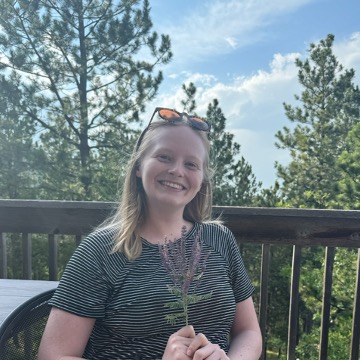
Early life
Sarah M. Coleman was born and raised in Austin, TX. She attended L.C. Anderson High School from 2011-2015, also receiving an International Baccalaureate (IB) Diploma upon graduation. Her Extended Essay, or mini-thesis, was about the golden ratio (\(\phi\)). Sarah continued her love of science and espeically chemistry through IB. She took three science courses her senior year and was the first person from her high school to receive a 7, the highest mark, on the higher level (HL) chemistry exam. The Anderson science faculty awarded her with the Bob Furtado scholarship, given to the student most passionate about science in every graduating class.
Sarah was also a high school athlete, serving on the varsity team at the Texas Rowing Center. In 2014, she was recognized nationally as a recipient of the 2014-2015 US Rowing Scholastic Honor Roll. Her proudest rowing career achievements are a tie between stroking a double at the Head of the Charles in 2014 or a second place finish in the quad at the 2014 USRowing Club Nationals.
Undergraduate work
Sarah enrolled in MIT in Fall 2015, receiving her S.B. in Chemical-Biological Engineering in Spring 2019. At MIT, she performed undergraduate research in the labs of Dr. Gregory Stephanopoulos (now retired) and Dr. Michael Strano, for two years and one year, respectively. With Dr. Stephanopolous, she developed anaerobic assays to evaluate enzymes involved in carbon dioxide metabolism. With Dr. Strano, she helped improve the duration time of light emitted from nanoparticles embedded in a living plant. Her undergraduate research with Dr. Strano assisted in an art exhibit at the Cooper Hewitt, Smithsonian Design Museum in Summer 2019 and a second author publication in Science Advances (see Publications).
During her summers at MIT, Sarah interned in pharmaceutical process development for vaccines and cancer therapeutics at Takeda Vaccines and Bristol-Myers Squibb, respectively. During the school year at MIT, Sarah worked as a math tutor for a local nonprofit, Girls’ Angle. Sarah was also a student leader; at MIT, she served as the President of the MIT AIChE Chapter (previously serving as Intracollegiate Chair and Sophomore Class Representative) and the Program Administrator of the Chemical Engineering Freshman Pre-Orientation Program (FPOP; previously serving as Head Counselor and Counselor of the Engineering division). She was also a second year-leader in MIT’s Gordon Engineering Leadership Program.
Graduate work
In Fall 2019, Sarah M. Coleman began her doctoral research in the Department of Chemical Engineering at The University of Texas at Austin (UT), in the lab of Dr. Hal S. Alper. Her early graudate career was supported by the prestigious Provost’s Excellence Fellowship and Thrust Fellowship. In Spring 2021, Sarah was awarded the NSF GRFP as a second-year graduate student. In 2022, Sarah was awarded the Green Fund Grant from The University of Texas at Austin Department of Sustainability to support her doctoral research. Sarah defended her PhD in Chemical Engineering in Summer 2024, with a dissertation entitled “A Yeast Grease Feast: Expanding waste valorization by Yarrowia clade yeasts to nontraditional and hydrophobic substrates”. Her graduate work focused on the genetic engineering of yeast to metabolize waste and produce industrially relevant chemicals. Along the way, she gained wet-lab experience in cloning, high-throughput screening, 3L bioreactor fermentations, chromatography, rheology, and many more analytical techniques. She was a productive graduate student, with five publications at the first- or co-first authorship level and 11 authorships total (see Publications).
In addition to her fully experimental PhD, Sarah increased her interest in machine learning, statistical analyses and bioinformatics. This was partially out of necessity (she needed to use these tools in her doctoral research) and partially because she found it really interesting! On top of all her late nights and weekends in lab, Sarah took nine additional courses at UT in advanced statistics, bioinformatics, and machine learning. This was enough to receive a M.S. in Statistics in Spring 2024. Again, this additional coursework during her PhD degree was optional and in an entirely separate discipline (well, except for one course she was able to count towards both degrees). To the best of her knowledge, Sarah is the only student in her doctoral program who graduated in five years with an M.S. in a different discipline.
Sarah brought her computational experience back to her PhD group. She became the TACC (Texas Advanced Computing Center) project lead for the Alper lab, developed bioinformatics pipelines, and hosted training seminars to help the rest of experimental group use these techniques. Although she now considers herself more proficient in R and Python, Sarah will never forget her first programming language, MATLAB. In fact, Sarah served as the MATLAB and Simulink Student Ambassador for the University of Texas at Austin from 2020 to 2021.
Sarah also continued her student leadership throughout her PhD. At UT Austin, she served as the President (previously serving as Outreach Coordinator and Enrichment Chair) of the Chemical Engineering Graduate Leadership Council (ChE GLC). She also organized the weekly 1st and 3rd year Graduate Student Seminars from 2021-2022 and served as a graduate recruitment chair for the 2020 season.
Postdoctoral work
In Fall 2024, Sarah began her position as a Postdoctoral Research Fellow in Environmental Biostatistics in the Department of Statistics and Data Sciences at The University of Texas at Austin under the supervision of Dr. Roger D. Peng. Sarah had enjoyed her statistics classes in graduate school immensely and desired a sabbatical of sorts where she could research in this area full time. Roger’s research focuses on the impact of outdoor air pollution on human health. With Roger, Sarah is interested in studying what interventions could be the most helpful, and how effective current interventions are. Currently, Sarah has published one paper with Roger (see Publications).
As an engineer at heart surrounded by career data scientists and statisticians, Sarah began fostering connections and relationships in her new department. In Summer 2025, Sarah (presenting author) won the Professional division of the JSM Data Science Expo Challenge, along with three other UT Austin postdoctoral fellows. They are hoping to publish an extended paper with their findings shortly where Sarah serves as first author!
Due to fellowship logistics, Sarah was unable to TA in graduate school. However, she had always wanted to experience teaching at the university level. In Spring 2026, Sarah was nominated by her advisor Roger to serve as the Instructor of Record for an upper-level undergraduate course at UT, Elements of Data Science (SDS 322E). She teaches this course in addition to her postdoctoral research responsibilities. In this role she manages the entire course, including lectures, assignments, and office hours, and also supervises three teaching assistants. She is enjoying the opportunity to lecture on the skills she learned as a graduate student, especially given her real-world background and experience in biotechnology.
Fun facts
Sarah founded a club at MIT, Fruit Club, with a former roommate. The purpose of this club is to hang out and eat fruit, with events such as “The Inaugural Melon Ball”. The motto of Fruit Club is “When life gives you lemons, bring them to Fruit Club”!
Sarah occasionally performed as TIM the beaver (the MIT mascot) in college!
Sarah’s Academic Family Tree (based on her PhD advisor lineage) goes back to the 1400s and includes Isaac Newton!
Sarah loves to garden. Her favorite thing she’s ever grown is a tie between a romanesco cauliflower (looks like a fractal) or giant rainbow colored carrots.
Sarah has a corgi named Chief! He is almost two years old and very cute.
Sarah LOVES fermentation both in and out of the lab, and is an avid kombucha brewer and sourdough baker. She gave a public talk about edible fermentation to Nerd Nite Austin in January 2026.